🏆 Who Discovered Tissue Culture? (Shocking History You Must Know)
Introduction: Why the History of Tissue Culture Still Matters in 2026
The history of tissue culture is one of biology’s most important success stories. From early experiments in the late 1800s to today’s cutting-edge biotech labs, tissue culture has revolutionised plant propagation, medical research, conservation, and even space exploration.

Caption: Modern tissue culture laboratory – sterile laminar flow hood and plantlets in culture vessels (2026 setup).
If you’re studying AP Biology in the USA or A-Level Biology in the UK, understanding the historical background of tissue culture is essential. Exam boards frequently test concepts like totipotency, aseptic technique, and the pioneers behind modern biotechnology. In this complete 2026 guide, we answer “who invented tissue culture”, provide a full tissue culture timeline, highlight the major key discoveries, and explore the latest modern applications.
1. The Historical Background of Tissue Culture (Late 1800s–Early 1900s)
The historical background of tissue culture begins with a simple but revolutionary idea: that cells could survive and grow outside a living organism.
In 1885, German embryologist Wilhelm Roux kept a salamander embryo alive in a salt solution for several days — the first crude attempt at maintaining living tissue outside the body. But the real foundation of tissue culture history came in 1902 when Austrian botanist Gottlieb Haberlandt published his groundbreaking paper on totipotency. He proposed that a single plant cell could develop into a complete plant. Haberlandt is rightly called the “father of plant tissue culture.”

Caption: Gottlieb Haberlandt – the father of plant tissue culture (1902).
2. Who Invented Tissue Culture? The Real Answer
Many students ask: who invented tissue culture? The honest answer is that it was a collaborative effort over several decades.
- 1907 – Ross Granville Harrison (USA): Successfully cultured frog nerve cells in a lymph clot. This experiment is widely accepted as the birth of animal tissue culture.
3. Complete Tissue Culture Timeline (1900–2026)
Here is the definitive tissue culture timeline every AP Biology and A-Level student should know:
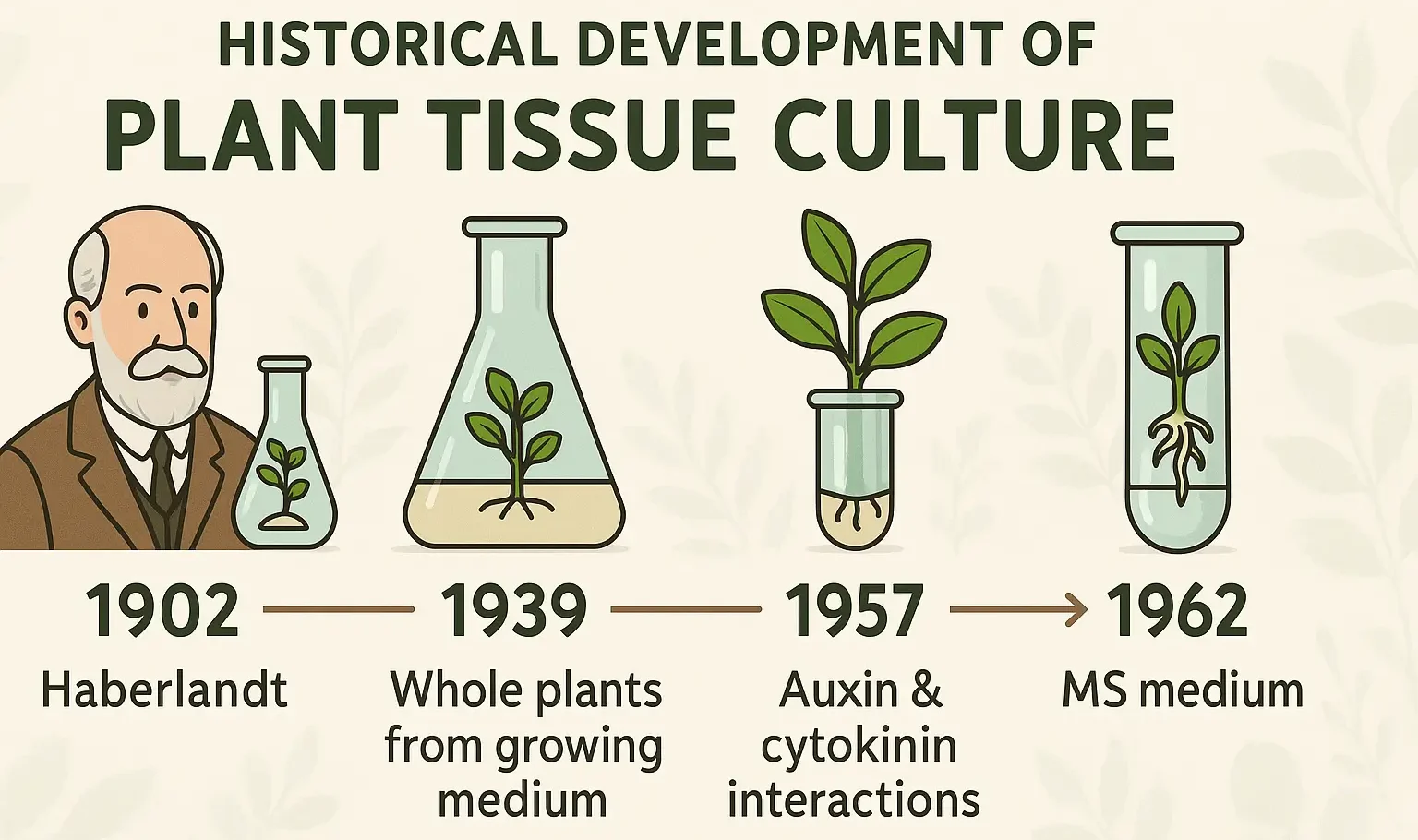
Caption: Complete illustrated timeline of plant tissue culture history (1902–1962 and beyond).
| Year | Milestone | Key Scientist(s) | Country | Why It Matters for Students |
|---|---|---|---|---|
| 1885 | First successful embryo maintenance | Wilhelm Roux | Germany | Early proof of concept |
| 1902 | Totipotency theory proposed | Gottlieb Haberlandt | Austria | Foundation of plant tissue culture |
| 1907 | First animal tissue culture | Ross Granville Harrison | USA | Birth of modern tissue culture |
| 1934 | Discovery of vitamin B in culture media | Philip White | USA | Enabled long-term cultures |
| 1939 | First continuous plant callus culture | Roger Gautheret | France | Commercial propagation begins |
| 1962 | Murashige & Skoog (MS) medium developed | Toshio Murashige & Folke Skoog | USA | Still the gold-standard medium in 2026 |
| 1960s | Virus-free plants via meristem culture | Morel & Martin | France | Revolutionised agriculture |
| 1970s | First somatic hybrid plants created | Carlson et al. | USA | Genetic engineering milestone |
| 1980s–90s | Micropropagation becomes large-scale commercial | Global labs (USA/UK) | USA/UK | Millions of plants cloned yearly |
| 2000s | Tissue culture used in NASA space biology experiments | NASA | USA | Astrobiology applications |
| 2012–2020 | CRISPR-Cas9 combined with tissue culture | Multiple (USA/UK labs) | USA/UK | Precision breeding |
| 2023–2025 | Lab-grown meat and organoids scaled commercially | Multiple biotech companies | USA/UK | Regenerative medicine boom |
| 2026 | AI-optimised tissue culture protocols & space-grown crops | Ongoing (NASA + UK Space Agency) | USA/UK | Current frontier |
4. Key Discoveries That Shaped Tissue Culture History
The evolution of tissue culture was driven by several breakthrough discoveries, including the development of the Murashige and Skoog (MS) medium.

Caption: Murashige & Skoog (MS) medium – the most widely used recipe in labs worldwide (still standard in 2026).
5. Modern Applications & 2026 Updates (USA & UK Focus)
The history of tissue culture directly powers today’s real-world applications:
Agriculture & Horticulture
- Disease-free banana, potato, and strawberry crops grown in UK and US commercial labs.
Medicine & Biotechnology
- Lab-grown skin, cartilage, and organoids for drug testing and personalised medicine.
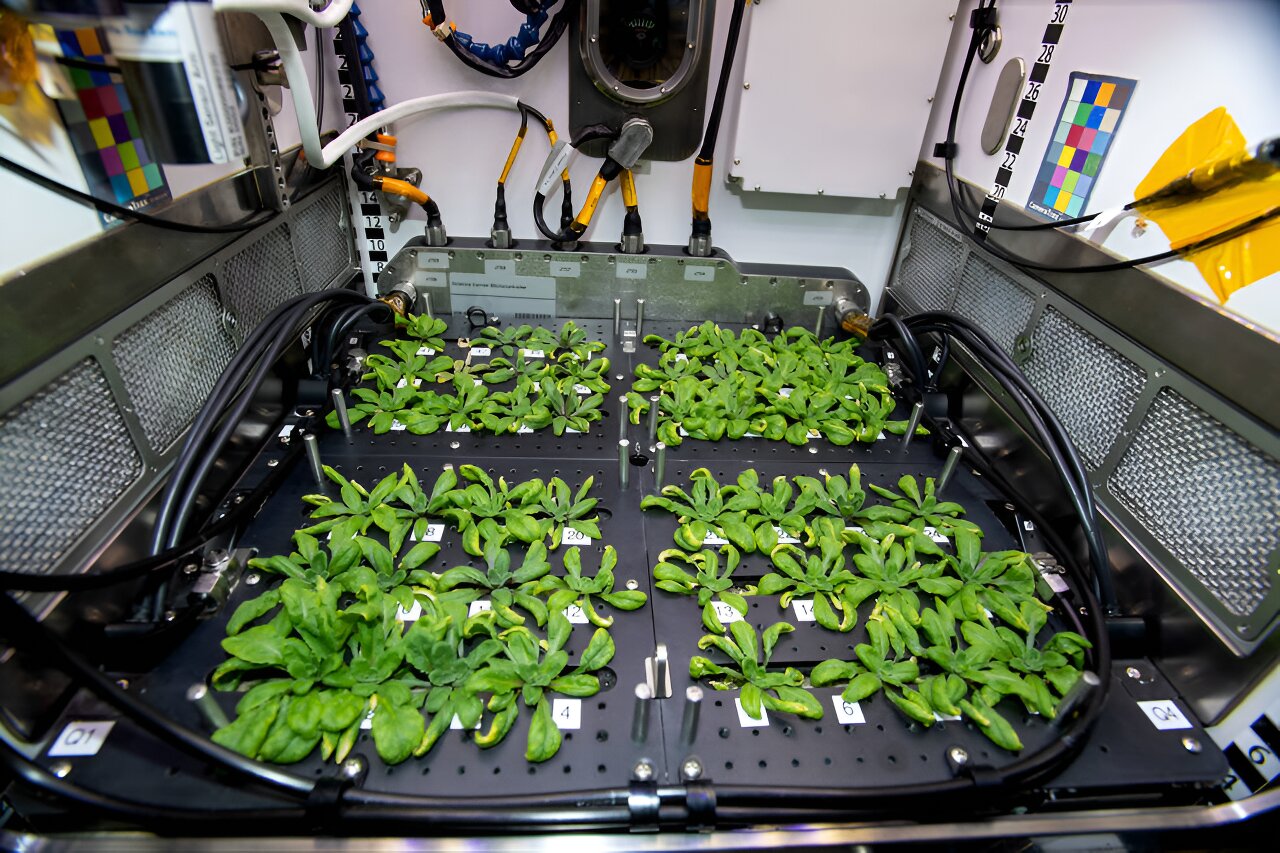
Caption: NASA space tissue culture experiment – plants growing in microgravity (2026 technology).
Space Biology & Climate Research
- NASA and the UK Space Agency use tissue culture to grow plants for future Mars missions.
6. Why This Matters for AP Biology & A-Level Exams
Understanding the tissue culture timeline helps you ace questions on cell totipotency, aseptic technique, and biotechnology applications.
Frequently Asked Questions (FAQ)
What is the historical background of tissue culture? It started with Roux in 1885 and Haberlandt’s totipotency theory in 1902.
Who invented tissue culture? Key pioneers are Haberlandt (plants), Harrison (animals), and White/Gautheret (practical techniques).
What is the history of plant tissue culture? From Haberlandt’s theory to modern micropropagation, CRISPR, and 2026 AI-optimised systems.
CRISPR stands for Clustered Regularly Interspaced Short Palindromic Repeats.
It is a natural bacterial defence system that scientists adapted into the most powerful gene-editing tool in history (CRISPR-Cas9).


0 Comments